
Gedung Kuliah I (GK I) FBSB UNY
Jl. Colombo No. 1 Yogyakarta 55281
Telp. (0274) 550843, 546719, Fax (0274) 548207
Website: pbi.fbs.uny.ac.id
Email: kaprodi.pbi@uny.ac.id
 Bahasa Indonesia
 English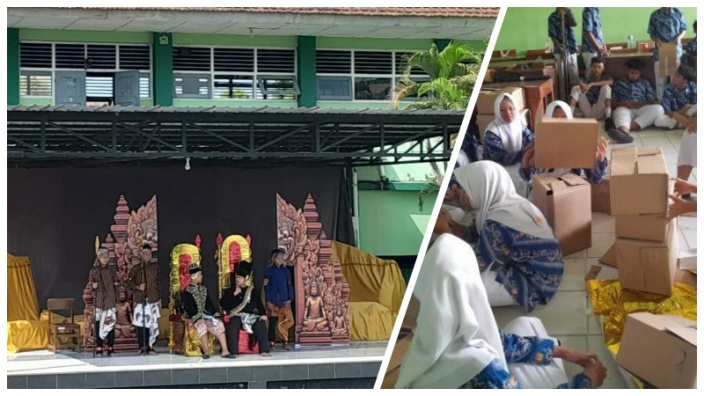
Folk tales are an important part of Indonesia’s cultural heritage that have been passed down from one generation to another. They contain elements such as characters, conflicts, plots, resolutions, and moral values, which are closely related to Narrative Text in English language learning. One form of Narrative Text is folktales, making local folk tales a relevant cultural context for language education. This connection is reflected in the school’s co-curricular Project-Based Learning (PjBL) activity on Local Wisdom, with the theme “Preserving Local Folk Tales.” The activity was conducted for Grade Eight students at SMP Negeri 3 Bantul from August 31 to September 4, 2026. The students worked collaboratively to develop local folk tales into mini drama performances in Indonesian. Although the performances were conducted in Indonesian, the activity remains relevant to English Language Education because the elements and structure of the stories can provide a meaningful context for teaching Narrative Text. In relation to the Sustainable Development Goals (SDGs), this activity primarily supports SDG 11: Sustainable Cities and Communities by introducing and preserving cultural heritage among younger generations. It also supports SDG 4: Quality Education by providing students with an active, creative, and collaborative learning experience.
The activity aimed to introduce students to local folk tales while developing their creativity, collaboration, and communication skills. The series of activities began on Monday, August 31, 2026, with a pre-test and activities connecting the project with several school subjects. On Tuesday, September 1, the students planned their dramas, completed the scripts, selected the actors, read the scripts, and discussed the distribution of tasks. During this process, students explored the plot, characters, conflicts, and resolutions of the stories, which are also commonly found in the structure of Narrative Text, including orientation, complication, and resolution. On Wednesday, September 2, the students practiced their mini dramas and prepared various supporting elements, including properties, background music, stage design, costumes, posters, and video trailers. Thursday, September 3, was used for a dress rehearsal, evaluation of the students’ roles and performances, evaluation of technical aspects and properties, revisions, and final practice. The activity concluded on Friday, September 4, with the mini drama performances, reflection, and a post-test. Throughout the activities, the students took an active role, while teachers and PK student teachers provided guidance and assistance during the preparation and implementation of the project.
The activity provided students with an active learning experience because they were involved in the process from planning to performance. Through group work, students learned to cooperate, share responsibilities, express their ideas, understand the characters they portrayed, and develop confidence in performing in front of others. The preparation of properties, costumes, posters, and video trailers also provided opportunities for students to express their creativity. From the perspective of English Language Education, this activity demonstrates that local folk tales can serve as meaningful and contextual resources for teaching Narrative Text. Although the drama performances were conducted in Indonesian, students were still engaged in understanding the essential elements of a narrative, such as the characters, sequence of events, conflicts, resolutions, and moral values. In relation to SDG 11, the activity contributed to introducing local folk tales to younger generations through a form of learning that was engaging and relevant to students. At the same time, it supported SDG 4 by developing students’ communication, collaboration, creativity, and sense of responsibility. Therefore, the activity not only resulted in a series of mini drama performances but also provided students with a meaningful learning experience while strengthening their appreciation of local cultural heritage.
The activity is expected to contribute to preserving local folk tales and increasing students’ awareness of the importance of cultural heritage. As a student of English Language Education, I found this activity meaningful because it showed me that language learning can be connected to cultural contexts that are familiar and relevant to students. Folk tales are not only useful as reading materials in Narrative Text but can also be developed into creative learning activities, such as role plays and drama performances. In the future, similar activities can be further developed by introducing a wider range of Indonesian folk tales and, when appropriate, adapting selected stories into English as materials for Narrative Text learning. In this way, cultural preservation and language education can support each other while providing students with meaningful and contextual learning experiences.
Contributor: Risna Azizah Silvianti